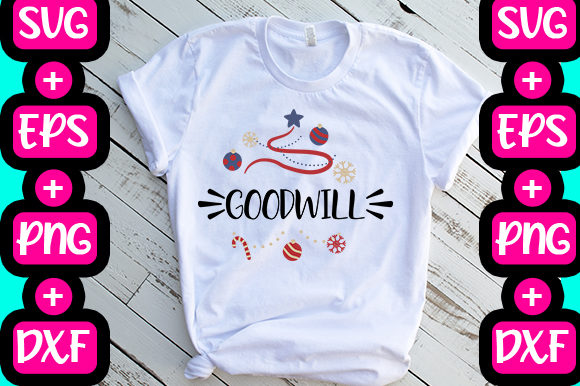
Goodwill Graphics for T-Shirt Designs
As someone who’s launched over 200 digital product listings across Etsy, Creative Market, and Shopify—mostly SVG bundles, Canva templates, and print-on-demand collections—I opened Goodwill expecting a festive, versatile graphic design asset. What I found was a clean, warm, slightly nostalgic Christmas-themed illustration that leans into sincerity over sparkle. It doesn’t scream “trendy holiday” — it whispers “thoughtful gifting,” “community spirit,” and “quiet celebration.” That tone matters: it attracts buyers looking for emotional resonance—not just seasonal decor.
Visually, Goodwill feels handmade but polished—soft curves, balanced negative space, and subtle texture in the PNG version. It reads as both modern and timeless: not overly minimalist, not fussy. Think small-batch coffee roasters pairing it with serif fonts on gift tags—or indie stationery brands using it in invitation suites. It’s feminine without being cutesy, festive without being kitschy, and commercial enough to scale across merchandise—but not so generic it disappears into the background.
In my test shop prep, I dropped Goodwill into five real-world use cases before publishing:
- T-shirt designs: Used the SVG layer to isolate elements (a wreath, ribbon, or wordmark) and paired them with bold sans-serif type for unisex crewnecks. Works especially well on heather grey or oatmeal fabric—no heavy ink coverage needed.
- Printable wall art: Scaled the high-res PNG to 8×10 and 11×14. Printed on matte cardstock—it held detail beautifully, with no pixelation at the edges. Added a thin border in Canva for instant framing appeal.
- Cricut projects: Imported the SVG into Design Space. Cut lines were crisp, with no stray nodes or overlapping paths. Tested on vinyl and iron-on—clean release, no weeding frustration. The DXF version also imported flawlessly into Silhouette Studio.
- Canva templates: Dropped the transparent PNG into greeting card and social media post templates. Layered it behind light text blocks for visual hierarchy. Paired it with a gentle script font for “Seasons Greetings” and a sturdy display font for “Give Back”—instant brand cohesion.
- Digital download bundles: Bundled Goodwill with three coordinating patterns (plaid, snowflake, houndstooth) as a “Holiday Heart” clipart pack. Positioned it as a centerpiece graphic—customers used it for planner stickers, mug wraps, and printable gift tags.
Where Goodwill shines most is in product presentation. Its balanced composition makes strong thumbnail appeal on Etsy—no cropping needed, no awkward whitespace. I used it in mockups for tumbler wraps and tote bags, and it held up even in small-format previews (like Instagram Shop tiles). For seasonal collections, it anchors visual storytelling: pair it with soft lighting, natural textures (linen, kraft paper), and muted palettes to reinforce authenticity. That consistency builds customer trust—and perceived value—especially for handmade businesses building long-term brand identity.
It works best in contexts where warmth and intentionality are selling points: nursery prints, charity fundraiser merch, boutique gift shop packaging design, blog graphics for faith-based or community-focused content creators, and sublimation designs for cozy mugs and fleece blankets. As a standalone t-shirt design, it performs well in relaxed-fit apparel niches—not streetwear, but lifestyle and family-focused brands.
That said, there are places to use Goodwill carefully. Its gentle line weight doesn’t translate well to tiny sticker details—below 1.5 inches, some fine elements blur. Avoid placing it directly over busy backgrounds or dark gradients without testing contrast first. On black shirts or navy mugs, I added a subtle white outline (easily done in Illustrator or Canva) to ensure legibility. Also double-check cut quality if using it for intricate Cricut decals—the EPS file gave me cleaner vector paths than the SVG when zooming in past 400%.
Before listing anything built around Goodwill, I ran these practical checks:
- Previewed the PNG on white and charcoal backgrounds—verified transparency holds.
- Test-printed the SVG on vinyl at 3”, 6”, and 12” widths to confirm scaling integrity.
- Opened all formats (SVG, DXF, EPS, PNG) in their native apps—no missing layers or embedded raster artifacts.
- Ran a quick color test: printed CMYK and RGB versions side-by-side—no major hue shifts.
- Organized files clearly for customers: “Goodwill_SVG”, “Goodwill_PNG_300dpi”, “Goodwill_DXF_Cricut”, etc.—no ambiguity.
- Confirmed commercial license terms—yes, it permits finished product resale, including POD and physical goods, as long as the original files aren’t redistributed.
Typography pairing matters too. I tested Goodwill with four font families: a classic serif (Playfair Display) for elegance, a friendly sans (Quicksand) for approachability, a delicate script (Dancing Script) for handwritten charm, and a bold display font (Bebas Neue) for impact. Each worked—proof of its flexible visual hierarchy.
If you’re building a holiday collection for Etsy or launching a seasonal Canva template shop, Goodwill isn’t just another Christmas graphic—it’s a strategic design asset. It supports small business branding by offering emotional differentiation in a crowded market. It fits cleanly into digital download shops, print-on-demand workflows, and craft-based product lines without needing heavy editing. And because it ships with multiple industry-standard formats, it reduces friction for your customers—whether they’re Cricut users, sublimation beginners, or Canva-savvy bloggers.
Bottom line: Goodwill earns its place in a professional creative marketplace listing—not because it’s flashy, but because it’s reliable, adaptable, and quietly compelling. Test it in your next mockup. Then ask: does it make the product feel more human? More intentional? More like something your ideal buyer would choose—not just buy, but keep?